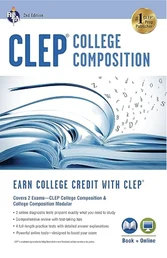
Studying for CLEP College Composition (also searched as “college composition CLEP” or just “CLEP composition”)? You’re in the right place. This is the full version of CLEP College Composition (different from the Modular variant), and it’s one of the highest-volume CLEP exams because many degree programs require a year of English composition and this exam can knock out 3 to 6 credits in one sitting.
Not sure this is the one to start with? browse the easiest CLEP exams to take first.
The full exam has about 50 multiple-choice questions plus two mandatory essays, all in 90 minutes. The multiple-choice section tests grammar, sentence-level revision, your ability to use source materials, and basic rhetorical analysis. The essays test whether you can actually write coherently under time pressure. If you’re looking for the no-essay version, see our CLEP College Composition Modular page.
Quick gut check before you keep reading: this page covers the full CLEP College Composition, the version with two required timed essays plus multiple-choice. There’s a separate CLEP College Composition Modular exam that drops the essays entirely and tests the same writing skills through multiple-choice only. Same subject area and (typically) the same credit, but a very different testing experience. If you already know you’d rather skip the essays, head to the modular page instead.
The multiple-choice section is the bulk of the exam (about 60% of your score), with the two essays making up the remaining 40%. The College Board breaks the multiple-choice content into four topic clusters with the rough weights below.
The exam covers four main multiple-choice categories, plus the two essays:
This section tests the mechanical rules: subject-verb agreement, pronoun-antecedent agreement, parallelism, modifier placement (especially dangling and misplaced modifiers), and standard punctuation (commas, semicolons, colons, apostrophes, hyphens). You’ll see sentences with underlined sections; your job is to spot the part that breaks a rule.
Spelling and capitalization fall here too, though the bulk of the points sit with grammar and punctuation. Don’t panic about obscure rules – the questions stay on the common stuff most college freshmen miss.
This is the largest single multiple-choice topic. You’ll be given a short passage and asked to identify the best revision of a sentence, the best ordering of sentences, or the best way to combine or split sentences for clarity and flow.
Key skills: recognizing wordiness, choosing precise words over vague ones, identifying topic sentences, spotting unclear pronoun references, and improving the logical flow between paragraphs. Many questions present four legitimate-sounding answer choices and ask for the “best” one – trust your ear, but verify by checking that the chosen option doesn’t introduce a new error.
Academic writing draws on sources, and this section tests whether you know how to handle them. Topics include recognizing when a citation is needed, distinguishing direct quotation from paraphrase from summary, identifying plagiarism, and integrating source material into your own writing without losing your voice.
You’ll also see questions on basic citation format (MLA, APA), the difference between primary and secondary sources, and how to evaluate source credibility (authority, currency, relevance, accuracy). You don’t need to memorize every MLA quirk, but you should recognize the major elements of a citation.
Given a passage, identify the author’s purpose (to inform, persuade, entertain, etc.), audience, tone, and main argument. You’ll also see questions on rhetorical strategies: appeals to ethos (credibility), pathos (emotion), and logos (logic); use of evidence; counter-arguments; and the role of specific stylistic choices (analogy, metaphor, anecdote, statistics).
The questions often ask “why did the author do X?” rather than “what is X?”. Practice reading short passages and being able to articulate the writer’s strategy in your own words.
The full College Composition exam includes two mandatory timed essays: one expressing your opinion on a given topic (about 30 minutes), and one analyzing and synthesizing two short readings (about 40 minutes). Together they count for roughly 40% of your final score.
Essays are scored holistically by trained college English instructors (not multiple-choice graders), using a 1 to 6 rubric. Top-scoring essays share a clear thesis, well-developed paragraphs, smooth integration of evidence (including direct reference to the provided sources in essay 2), varied sentence structure, and minimal mechanical errors.
Don’t over-prepare for specific essay topics – you can’t predict them. Do practice writing a five-paragraph essay (introduction, three body paragraphs, conclusion) in 25 minutes so the structure is automatic. Save 5 minutes at the end for proofreading.
Correct Answer: B. Walking through the park, the trees seemed to whisper.
Explanation: A dangling modifier opens a sentence with a participial phrase that has no logical subject to attach to in the main clause. In option B, “Walking through the park” appears to modify “the trees,” but trees can’t walk. Option A is correct because the participial phrase logically modifies “I.”
Correct Answer: C. She likes hiking, swimming, and biking.
Explanation: Parallel structure means items in a series share the same grammatical form. All three items in option C are gerunds (-ing forms). The other options mix gerunds with infinitives (“to hike,” “to bike”), which breaks parallelism.
Correct Answer: B. Because it was raining, we decided to cancel the picnic.
Explanation: “Due to the fact that” is wordy filler for “because.” “Made the decision to cancel” is wordy filler for “decided to cancel.” Option B replaces both with their direct equivalents while preserving the meaning. The other options either keep the wordiness or introduce new awkwardness.
Correct Answer: B. The meeting was scheduled for Friday; however, it was postponed until the following week.
Explanation: “However” is a conjunctive adverb, not a coordinating conjunction. When it joins two independent clauses, it requires a semicolon before it and a comma after it. Using just a comma (options A, C, D) creates a comma splice.
Correct Answer: C. Paraphrasing a specific statistic from a 2022 research article
Explanation: Any specific information from a source – even when paraphrased – requires citation. Common knowledge (option A), original ideas (option B), and standard dictionary definitions (option D) generally don’t need a citation. The key test: would a reasonable, educated reader already know this, or did you have to look it up?
Correct Answer: B. The United States should accelerate its transition to renewable energy because doing so reduces long-term electricity costs, improves national energy security, and slows climate change.
Explanation: A strong thesis takes a clear position (“should accelerate”) and previews the supporting reasons. Option A is vague; option C describes what the essay will do rather than stating a position; option D is non-committal. B gives the reader exactly what to expect and stakes a defensible claim.
Correct Answer: C. Logos
Explanation: Logos is the appeal to logic and evidence – data, statistics, research, reasoning. Ethos is the appeal to credibility (the writer’s authority); pathos is the appeal to emotion. Citing a peer-reviewed source has elements of ethos too (the source is credible), but statistics specifically are logos.
Correct Answer: B. When Maria spoke with her sister, Maria was frustrated.
Explanation: In the original sentence, “she” could refer to either Maria or her sister. Option B clarifies by repeating the proper noun. Option A adds a detail but doesn’t fix the pronoun ambiguity. Option C introduces a comma splice. Option D moves “she” before “Maria,” which still leaves the same ambiguity.
Correct Answer: C. Yes, because copied text must be in quotation marks (or set off as a block quote) with an in-text citation, even when the source is in the bibliography
Explanation: Direct quotation without quotation marks is plagiarism even if the source is listed in the bibliography. The bibliography signals that you consulted the source; quotation marks and an in-text citation are what tell the reader which specific words are not your own. Both are required for direct quotation.
Correct Answer: B. To state the main idea of the paragraph it begins
Explanation: A topic sentence (usually the first sentence of a body paragraph) states the controlling idea of that paragraph – what the rest of the paragraph will support. It’s typically narrower than the thesis (which controls the whole essay) and broader than the specific evidence that follows.
The exam on this page is the full CLEP College Composition: about 50 multiple-choice questions plus two mandatory timed essays. CLEP College Composition Modular covers the same skills but drops the essays entirely, so it’s all multiple-choice. Check with your target school first, since some programs only accept credit from one version.
The multiple-choice section covers four areas: conventions of standard written English, revision skills, using source materials, and rhetorical analysis. Then you write two timed essays, one opinion essay and one that analyzes and synthesizes two short readings. See the study guide above for the full breakdown.
Start with the four multiple-choice categories above so you know what’s actually being tested, then practice writing a five-paragraph essay in about 25 minutes until the structure feels automatic. The study resources below round out a solid prep plan.
It’s one of the more time-intensive CLEP exams since you’re writing two full essays under a clock, not just answering multiple-choice. That said, it’s also one of the highest-volume CLEP exams precisely because so many degree programs require it, so plenty of people pass it every year with focused prep.
Full disclosure: this one's ours, so I'm about as biased as it gets. It's the study app I always wished existed back when I was doing this: every CLEP and DSST exam in one subscription, real timed practice exams, and a live pass-readiness score so you're not left guessing whether you're actually ready to book the test. It's iPhone-only for now (sorry, Android folks). But there's a 7 day free trial, so you can judge for yourself whether I'm too biased to be trusted here.
Built by a former student, Flying Prep's got what we need: easy to learn flashcards (with mobile-first design), full length practice exams, and complete coverage of every CLEP exam. Plus a dual guarantee including a 30 day satisfaction no-questions-asked guarantee and 6 month exam protection.
While quite short on the study side of things, the official CLEP book is the go-to final practice test. Since this is the only official practice test available, I normally use it as my final spot check before taking the test.
REA offers a great combination of study guide and practice questions. This book functions well as the central pillar of a strong CLEP prep strategy, with resources like the Official CLEP Study Guide (above) providing a great final practice test at the end.
Though the design is now quite dated, InstantCert is one of the OGs in the space. They offer flashcards to study for the exam, but their coverage is somewhat limited and I'm not sure whether they use spaced repetition or other modern study science.